
-A Servant Of All
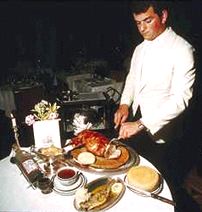
Character is always more important than work.
A Servant Of All
Each gospel writer presents a different aspect of the character of the Lord Jesus, and it is generally recognized that Mark presents Him as the perfect Servant. The key verse in his gospel is, “For even the Son of man came not to be ministered unto, but to minister, and to give His life a ransom for many” (Mk. 10:45 KJV). He came to serve, and by His life the Lord Jesus has shown us what it means to be “servant of all” (Mk. 10:44).
However, one of the finest examples of our Lord’s service is not found in Mark’s gospel but in John’s. When we remember that John presents the Lord Jesus as the Son of God, it makes the example all the more telling. In the opening verses of John 13 we find the Lord Jesus rising from supper to do what none other would do. He, the Son of God, “laid aside His garments, and took a towel, and girded Himself … and began to wash the disciples’ feet” (Jn. 13:4-5).
The Stoop
Isn’t this amazing? Already He had laid aside those garments of glory that were eternally His and had clothed Himself in human flesh. Now He humbled Himself further: “He made Himself of no reputation, and took upon Him the form of a servant” (Phil. 2:7-8). And on bended knee He went from one disciple to the next, washing their dirty, hot and tired feet — something that none of His followers had been prepared to do. What grace!
Peter never forgot that incident. At the time, he had felt it wrong that the Lord should wash his feet, but Jesus had explained that He was leaving the disciples a practical example of humble service (Jn. 13:6,15). Years later Peter recalled the obedient service and patient suffering that Christ displayed, and wrote that we should “follow His steps” (1 Pet. 2:21). Let us consider some of those steps as they are recorded in Mark’s gospel and some of the glimpses of true service that we are given.
When we open Mark’s gospel we discover that the Lord Jesus was preceded by another servant, His forerunner, John the Baptist. The first thing to notice about John is that He was a messenger who was sent: “Behold, I send My messenger before Thy face, which shall prepare Thy way before Thee” (Mk. 1:2).
Being sent implies that one has already been called, and the call requires obedience. If we are to serve the Lord, we too must be called by Him, and we must obey that call. Like John the Baptist, and like the Lord Jesus Himself, we must be sent.
The Character
Character is always more important than work, and in his gospel Mark reveals to us a number of features that should be found in the servant’s life. The first characteristic is humility. This was clearly seen in John’s own life as he pointed men and women away from himself and to the One who was “mightier” (Mk. 1:7).
Humility is a grace that does not come naturally to any of us. On the road to Capernaum one day, the disciples vied with one another for greatness and had to be taught a lesson by the Lord: True greatness is found in being a “servant of all” and in receiving the most humble of people in His name (Mk. 9:33-37).
Not long afterwards, the subject arose again when the two sons of Zebedee asked for positions of prominence in the coming kingdom. Once again, the Lord patiently taught them the need to take the lowly place, and it was this incident that gave rise to the statement that we have already considered about the purpose of His own ministry (Mk. 10:33-45).
Two other related features that must mark the servant’s life are compassion and prayer. The Lord Jesus was “moved with compassion” when He saw the people as sheep without a shepherd (Mk. 6:34). The humble servant will always consider others better than himself and thus will feel compassion when he sees others who are in need.
Prayerfulness must also characterize the servant’s life. Jesus, the perfect servant, arose “a great while before day” and went out to pray in a solitary place (Mk. 1:35). Effective service is not possible without prayer. The Lord Jesus experienced opposition, both from the devil (Mk. 1:12-13) and from His own family (Mk. 6:2-3). We must expect opposition as well, and for this reason prayer is all the more necessary.
The Service
Mark records a number of incidents that reveal to us exactly what service involves. The four men who carried their invalid friend on a stretcher teach us the necessity for perseverance in the important work of bringing needy people to Jesus (Mk. 2:1-4). The Lord Himself “went about doing good” and demonstrated that Sabbath regulations could never override acts of compassion (Acts 10:38; Mk. 3:4-5). Like Him, we must seek to do good to others.
The ultimate characteristic of the servant, however, is complete self-surrender to God. The Savior commended a poor widow whose two small coins amounted to more than all the abundance of the rich, for she had given her all (Mk. 12:41-44). Not many days later the Lord Jesus gave His all when He laid down His life for us on Calvary’s cross.
Service like this is costly, but the Lord’s love for us proves that it is not too costly. We will learn more about service as we meditate upon the Perfect Servant and seek, with the Holy Spirit’s help, to be more like Him.
By Martin Girard
With permission to publish by: Sam Hadley, Grace & Truth, 210 Chestnut St., Danville, IL., USA.
Website: www.gtpress.org
 tafj.org
Leave a comment